

Building a career in climate

A career in climate is a rewarding experience because it allows you to work on intellectually challenging issues and make a meaningful contribution to society. A few years ago, climate change was high on the political agenda and finding a job in this field was relatively straightforward. Many graduates transitioned from university to NGOs, the public sector, consulting, among other things, or stayed in academia (e.g. to pursue a PhD).
These opportunities still exist, but some climate jobs, especially those dependent on public or philanthropic funding, have become scarcer. Russia’s attack on Ukraine and a more aggressive US foreign policy have shifted policy makers’ attention to national security. In addition, the US administration is cutting funding for everything related to climate policy. This affects the job market well beyond the US, as American colleagues who have lost their job or who are unhappy with their current situation increasingly seek employment elsewhere.
Nevertheless, if you aim to build a career in climate, there are still opportunities for you even under the current circumstances. In the following, I discuss four key principles for a successful career in climate. These include building on your specific skills, relying on your professional network, exploring other fields that have a direct connection to climate and adopting a long-term perspective to career development.
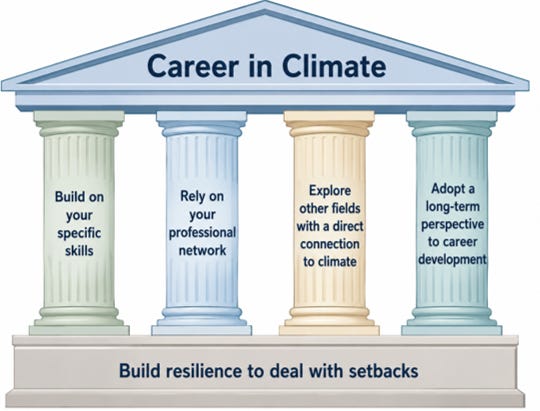
1. Build on your specific skills
Think closely what kind of experience you have that makes you stand out. For example, you might have previous experience with a certain economic sector on which you can build. Or you might know more than most people about a specific country, perhaps because you have lived and worked there. And of course any applied skills, such as quantitative analysis, project management, fundraising or writing for selected audiences, can help sharpen your profile. It can help to write down your specific knowledge and identify combinations of strengths that few others can offer.
This allows you to identify potential employers for whom these experiences can be valuable. Let them know that you are looking for a job, even if they currently are not hiring. Something might come up soon, or if they are really interested in your profile, they might make the effort of creating a position for you.
2. Rely on your professional network
A well-established professional network is key for successful professional development. Being in touch with well-informed people helps you follow recent developments in climate policy (including methods and data). Contacts with people who are motivated to do something to address climate change can also help boost your morale. Finally, talking to people who are well-connected in a field you are interested in can provide valuable information on potential roles for you.
Start building up your network early on. I don’t think it is advisable to be too strategic here. Focusing on how useful people might be for you later on won’t put you in a state of mind that lets you really see who they are and what particular strengths they have. Instead, meet up with like-minded people you find enjoyable and learn from their experiences. And don’t be shy to reach out to people working in a field that you are interested in. Even though they might be quite busy, they usually appreciate your interest and are happy to meet up if they can find the time. Such meetings can also point you to job openings you were not aware of.
3. Explore other fields with a direct connection to climate
Not every position that helps address climate change is actually labelled as a climate job. For instance, more and more actors whose main motivation is profit (and not climate change mitigation) are moving into renewable energy and electric mobility because of the growth potential there. You might think of a utility that is increasingly switching to renewables because they are the cheapest form of supplying power, a car company that is moving toward electric mobility because of consumer demand or a financial institution that increasingly invests in green assets because of their market potential. Likewise, national security considerations favor transitioning away from fossil fuels to reduce import dependence. The public health community also increasingly recognizes the importance of climate change. Think closely if any of these sectors could be of interest to you.
You might feel a bit less excited about working in a field in which climate change mitigation comes as a by-product of other objectives, such as company profits or national security, instead of being the main motivation. Nevertheless, such a job could permit you to do something that is meaningful for the climate. At the same time, it helps you gain valuable experience that you can use to move to a role that predominantly focuses on climate at a later stage.
4. Adopt a long-term perspective to career development
Sometimes, the best route into climate work is not the most direct one. You can take a different job that acts as a stepping stone for a career in climate. In addition to thinking about the skills you already have (as discussed under Principle 1), a long-term perspective takes skill development into account. Make up your mind on what kinds of skills you can pick up in different jobs and how this could help you later on. General skills, such as project management, leadership or IT are always helpful and can make a difference if you later look for a position in climate. Gaining inside knowledge of a specific industry can be a valuable experience for devising decarbonization strategies for it.
If you decide to take this route, take good care to keep track of the most recent developments in climate policy. Follow the latest news on the web, listen to climate podcasts and attend public events where climate issues are discussed. Furthermore, stay in touch with people from the community to learn in which direction the debate is developing. With a bit of luck, this could guide you toward employment opportunities in the climate field.
*****
Underlying these four principles is the ability to deal with setbacks and frustrations. You might have to send out quite a few applications before you get invited to some interviews. You probably will have to do quite a few interviews to get a job offer. Once you have a job, you may not be completely happy with every single aspect of it (for instance how the organization is structured or the workload assigned to you). All this is part of the world of work and people rarely find a position that is absolutely perfect. Building up the resilience to stay the course in challenging circumstances and becoming aware of how you can shape your situation is key for professional development. This resilience does not have to be there from the start; it can gradually develop as you gain experience, learn from setbacks, and become clearer about the kind of work that suits you.
The above principles provide a framework of how one can think of developing a career in climate. In the next post, I will discuss how this framework can help to match your skills and goals with potential employers.
If you are thinking about your own path in climate work, I also offer coaching for people in climate, sustainability, and research. More information is available here.